Which AI model should your bot use?
The right model for the job, tested.
17 models, the same jobs on a real computer, three tries each. See which ones work and what a finished task costs.
Where each model breaks
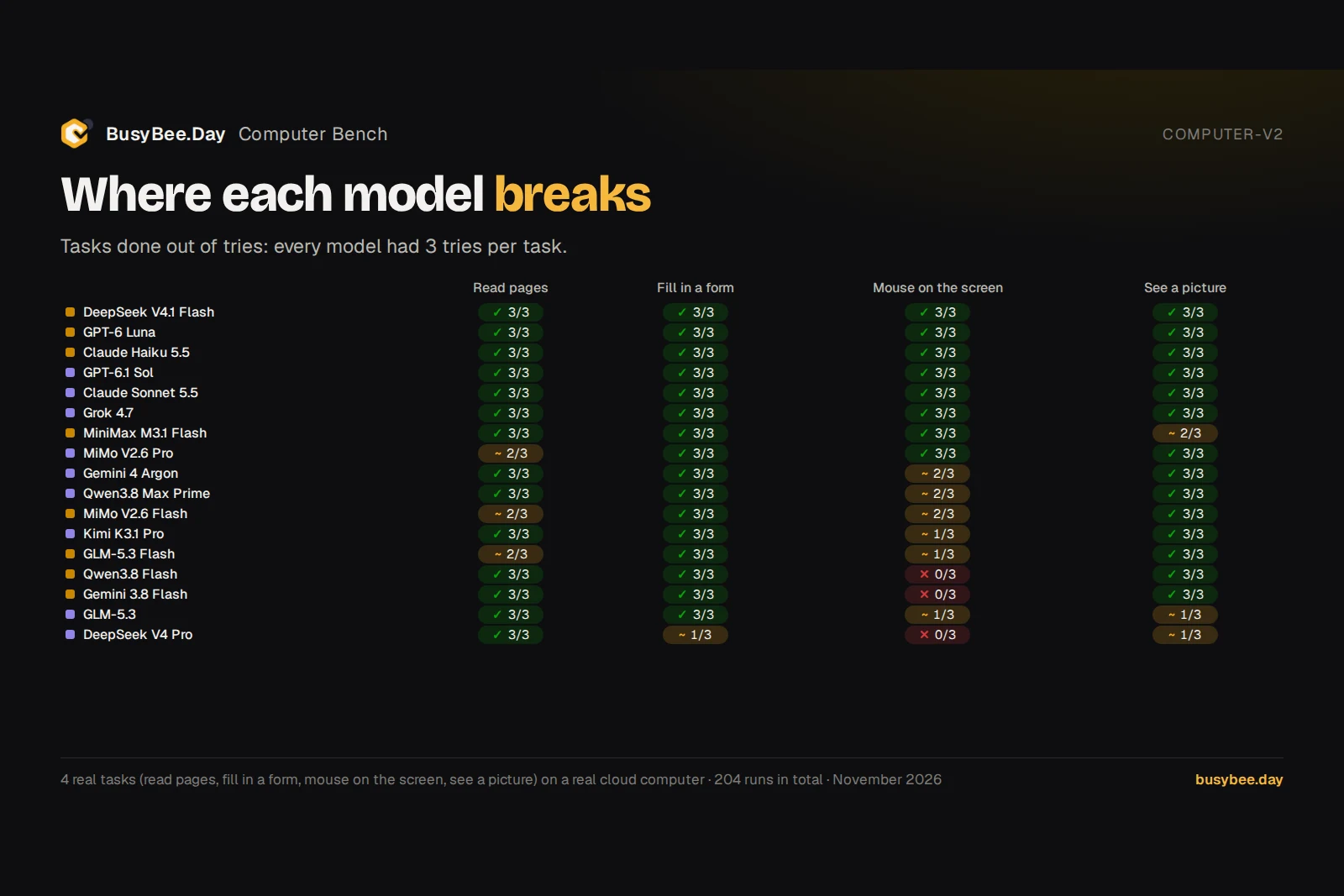
Jobs done out of tries, per model and job.
What a finished task costs
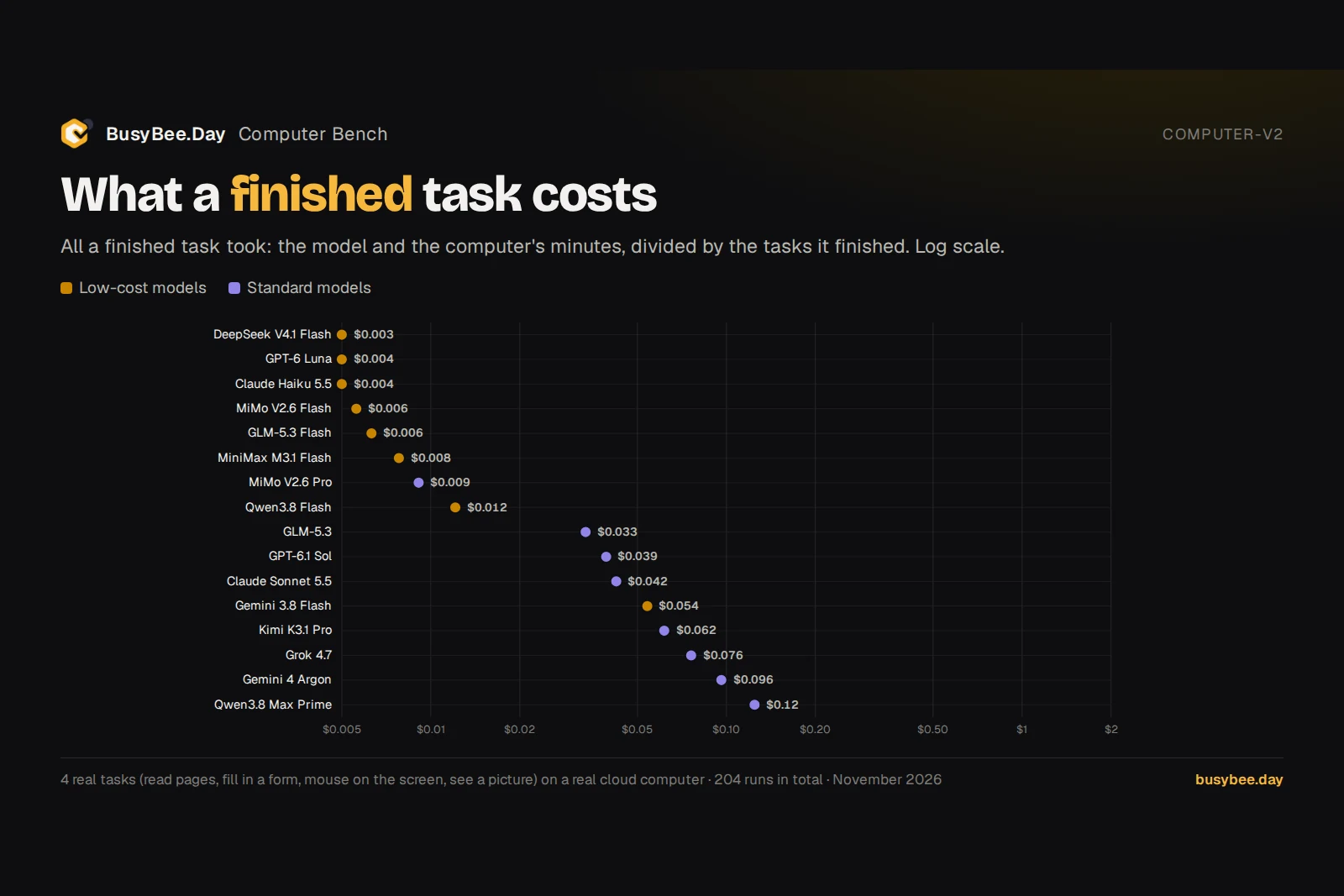
From a fraction of a cent to twelve cents.
Our picks
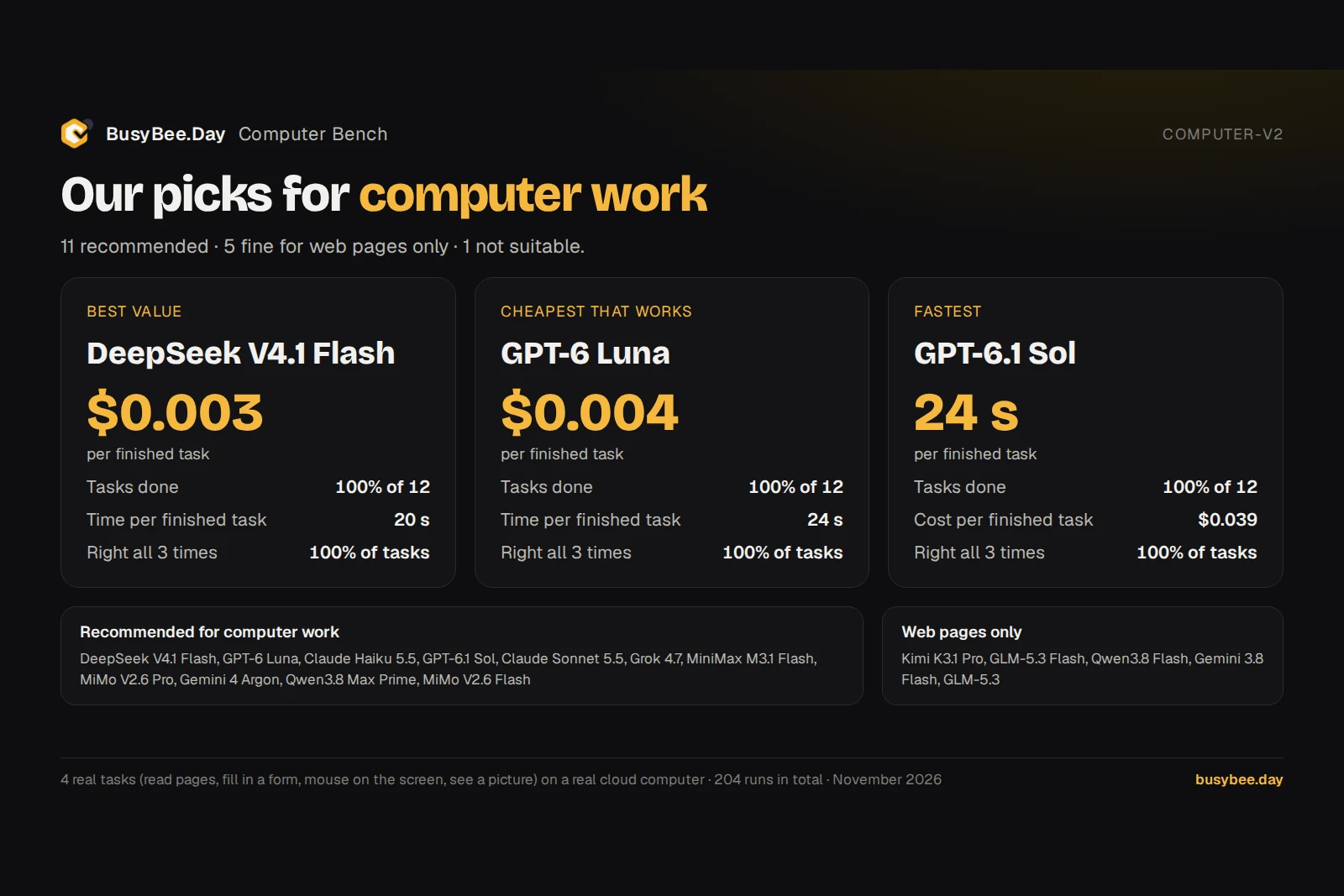
Best value, cheapest that works and fastest.
Short answer
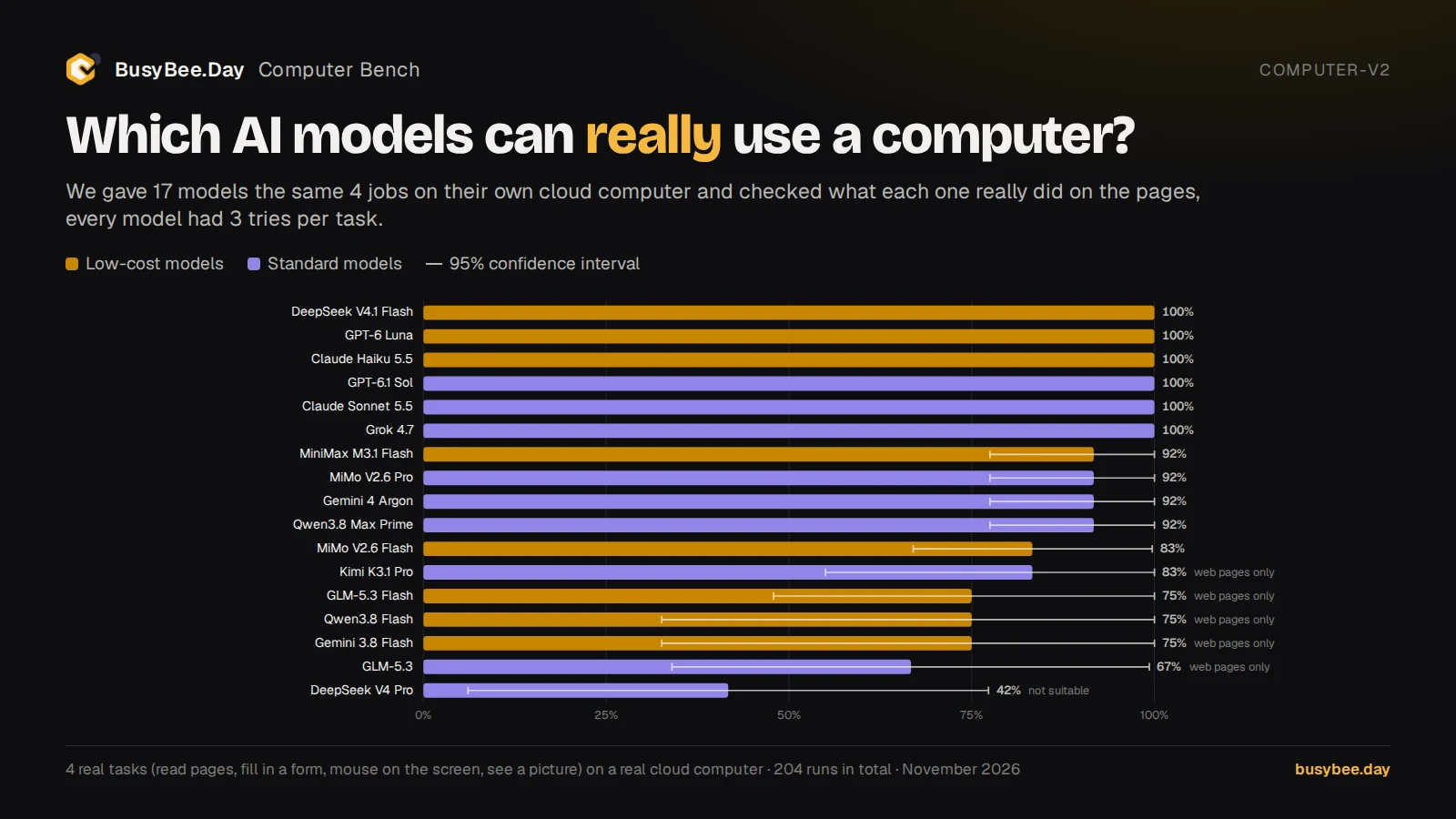
For work on a computer, pick a model that finished every task in our test: DeepSeek V4.1 Flash, GPT-6 Luna and Claude Haiku 5.5 cost under half a cent per finished task, and GPT-6.1 Sol, Claude Sonnet 5.5 and Grok 4.7 suit harder work. For chat, documents and tasks without a computer, any model will do.
The results
Each model did four jobs on its own cloud computer, three times each, with new values every time. A job counts only when the page shows it was really done.
Best value: DeepSeek V4.1 Flash
$0.003 per finished task · 20 s · Tasks done 100%
Cheapest that works: GPT-6 Luna
$0.004 per finished task · 24 s · Tasks done 100%
Fastest: GPT-6.1 Sol
$0.039 per finished task · 24 s · Tasks done 100%
| Model | Tasks done | Read pages | Fill in a form | Mouse | Read a picture | Cost per finished task | Time per task | Verdict |
|---|---|---|---|---|---|---|---|---|
| DeepSeek V4.1 FlashFast model | 100% | 3/3 | 3/3 | 3/3 | 3/3 | $0.003 | 20 s | Recommended |
| GPT-6 LunaFast model | 100% | 3/3 | 3/3 | 3/3 | 3/3 | $0.004 | 24 s | Recommended |
| Claude Haiku 5.5Fast model | 100% | 3/3 | 3/3 | 3/3 | 3/3 | $0.004 | 32 s | Recommended |
| GPT-6.1 SolStandard model | 100% | 3/3 | 3/3 | 3/3 | 3/3 | $0.039 | 24 s | Recommended |
| Claude Sonnet 5.5Standard model | 100% | 3/3 | 3/3 | 3/3 | 3/3 | $0.042 | 26 s | Recommended |
| Grok 4.7Standard model | 100% | 3/3 | 3/3 | 3/3 | 3/3 | $0.076 | 38 s | Recommended |
| MiniMax M3.1 FlashFast model | 92%78% - 100% | 3/3 | 3/3 | 3/3 | 2/3 | $0.008 | 28 s | Recommended |
| MiMo V2.6 ProStandard model | 92%78% - 100% | 2/3 | 3/3 | 3/3 | 3/3 | $0.009 | 40 s | Recommended |
| Gemini 4 ArgonStandard model | 92%78% - 100% | 3/3 | 3/3 | 2/3 | 3/3 | $0.096 | 40 s | Recommended |
| Qwen3.8 Max PrimeStandard model | 92%78% - 100% | 3/3 | 3/3 | 2/3 | 3/3 | $0.12 | 28 s | Recommended |
| MiMo V2.6 FlashFast model | 83%67% - 100% | 2/3 | 3/3 | 2/3 | 3/3 | $0.006 | 32 s | Recommended |
| Kimi K3.1 ProStandard model | 83%55% - 100% | 3/3 | 3/3 | 1/3 | 3/3 | $0.062 | 36 s | Web pages only |
| GLM-5.3 FlashFast model | 75%48% - 100% | 2/3 | 3/3 | 1/3 | 3/3 | $0.006 | 24 s | Web pages only |
| Qwen3.8 FlashFast model | 75%33% - 100% | 3/3 | 3/3 | 0/3 | 3/3 | $0.012 | 32 s | Web pages only |
| Gemini 3.8 FlashFast model | 75%33% - 100% | 3/3 | 3/3 | 0/3 | 3/3 | $0.054 | 44 s | Web pages only |
| GLM-5.3Standard model · cannot see the screen | 67%34% - 99% | 3/3 | 3/3 | 1/3 | 1/3 | $0.033 | 32 s | Web pages only |
| DeepSeek V4 ProStandard model · cannot see the screen | 42%6% - 77% | 3/3 | 1/3 | 0/3 | 1/3 | $0.14 | 48 s | Not suitable |
Tested on November 8, 2026 · 204 tries in total. The small range under each share is its 95% confidence interval. The cost is the model and the computer's minutes, divided by the tasks the model finished.
How to choose
- 1
Work on a computer
For filling in forms, using websites and moving things with the mouse, pick a recommended model. The fast ones cost less than half a cent per finished task.
- 2
Hard or long jobs
For research, writing and jobs with many steps, a standard model such as GPT-6.1 Sol or Claude Sonnet 5.5 is worth its higher price.
- 3
Without a computer
Chat, documents and tasks need no computer, and every model handles them. Start with a fast model and change it if the answers fall short.
- 4
Check your plan
Fast models are on every plan, standard models from Basic and premium models on Max. The bot's computer comes with Pro, Team and Max.
- 5
Set it once or per chat
Choose a default model for all your bots, give one bot its own model, or change the model of a single chat in its model picker.
How we tested
- Four jobs on a test site on each model's own computer: read a catalog over three pages, fill in an order form with every kind of field, drag a card on a board and point at a person with the mouse, and read a parcel label in a photo.
- Every try got new random values, so no answer could be known in advance.
- A job counted only when the site recorded it: the order it received, where the card was dropped with a real mouse, the number typed in. What a model only said it did does not count.
- Three tries per job for every model. A try stopped after 20 model steps or 4 minutes.
- A try where the model's provider did not answer was run again and is not counted against the model.
- A try that read the test's own files or called its recording addresses failed.
What the test does not cover
Premium models (Claude Opus 5.5, Claude Fable 5.1 and GPT-6 Astra) were not tested: they cost several times more, and we expect them to manage these jobs.
Models change, and so do their prices. We run the same test again when models are added or updated, and this page shows the latest run.
Questions and answers
Which model is best for a bot that uses its computer?
Any model marked recommended. In this run DeepSeek V4.1 Flash, GPT-6 Luna and Claude Haiku 5.5 finished every job for under half a cent per task, and GPT-6.1 Sol, Claude Sonnet 5.5 and Grok 4.7 finished every job too.
Why are some models for web pages only?
They read pages and fill in forms well, but failed the mouse or the picture jobs too often, or cannot see the screen at all. They are fine for work in a browser that needs no mouse.
Can a model that cannot see the screen use a computer?
Partly. It can read pages and use the terminal, and some even installed text recognition to read the picture, but it cannot be trusted with work that needs eyes on the screen.
Why were premium models left out?
They cost several times more than the others, and we expect them to manage these jobs. Testing them in every run would make the test too expensive to repeat often.
How often is this updated?
We run the same test again when models are added or updated. The date under the results says when the numbers were measured.